There is a moment, in a workshop, when a finished blade is dipped into an acid bath. For a few minutes nothing visible happens. Then the metal begins to speak: waves, concentric circles, lines rippling like a current under ice. The pattern had been there all along, locked inside the thickness of the steel.
That is damascus steel. Not an engraving, not a print, not a surface treatment: an internal architecture, stacked and forged, that acid merely reveals.
Here is how those patterns are born, what they tell you about a blade, and what they do not.
What damascus steel actually is
Damascus steel today means a composite steel made by forge welding several grades of steel together, then forging and folding them. The alternating layers react differently to an acid bath: some darken, others stay bright, and the pattern appears.
The word actually covers two very different things. Historical damascus, the steel of oriental blades, is a crucible steel called wootz: a single metal whose patterns come from the way it crystallises. Modern damascus is pattern-welded: several different steels, welded together in the forge.
In the second case, everything rests on a chemical contrast. A nickel-rich steel, which resists the acid and stays bright, is usually paired with a carbon steel, which darkens. The visible pattern is therefore nothing but a cross-section of the stack, as it surfaces on the blade after grinding.
In other words: the cutler does not draw a pattern onto the steel, he builds a volume and then slices through it. What you see on the blade is a section through that layered material.
Wootz: the true damascus, and its lost secret
Wootz is the steel of the historical Damascus blades, made in crucibles in India and forged in the Near East. Its patterns come from a banding of carbides triggered by trace elements such as vanadium present in certain ores. The craft died out between the 17th and 18th centuries, as those ores ran out.
For centuries, so-called Damascus blades fascinated the West without anyone being able to reproduce them. They came from wootz ingots melted in southern India, then forged at low temperature by Near Eastern smiths. Their surface carried a watered figure no European steel could produce.
The mystery was only solved in the late 20th century. Metallurgist John Verhoeven and bladesmith Alfred Pendray showed that the pattern came from a banding of iron carbides aligned in sheets through the metal, and that this banding depended on minute traces of carbide-forming elements, vanadium first among them, present at only a few dozen parts per million.
Those traces came from the ore itself, mined in specific deposits. When those sources ran dry, around the middle of the 18th century, the recipe died with them: generations of smiths had repeated a gesture whose chemical cause they never knew. It is probably the finest lesson in humility in the history of metallurgy.
The damascus forged today, in Thiers as elsewhere, is therefore not that wootz. It is a cousin by appearance, not by nature.
Forge welding: stack, weld, fold
Pattern-welded damascus starts from a stack of steel sheets of at least two grades. Heated to around 1,200 °C, the billet is welded under the hammer, drawn out, folded back on itself, then reheated and folded again. Each fold doubles the number of layers.
The starting point fits in your hand: a block of alternating sheets, wired together, dusted with a flux that protects the surfaces from oxidation. That block goes into the fire until welding temperature, the moment when the steel turns yellow-white and the layers agree to become one.
Then comes the folding. You weld under the hammer or the press, draw the bar out, fold it and start again. The progression is geometric: a seven-layer stack folded six times yields close to five hundred layers. Which is why blades advertised at 200, 300 or 500 layers are nothing remarkable in themselves — that is arithmetic, not a feat.
The craft lies elsewhere: in the cleanliness of the welds. One oxide inclusion, one badly spread flux, one missed heat, and a layer fails to take. The flaw can stay invisible until final polishing, sometimes until use. A failed damascus bar goes to scrap after hours of work, and that risk, as much as the time spent, is what makes a damascus blade expensive.
Where the patterns come from: ladder, raindrop, twist
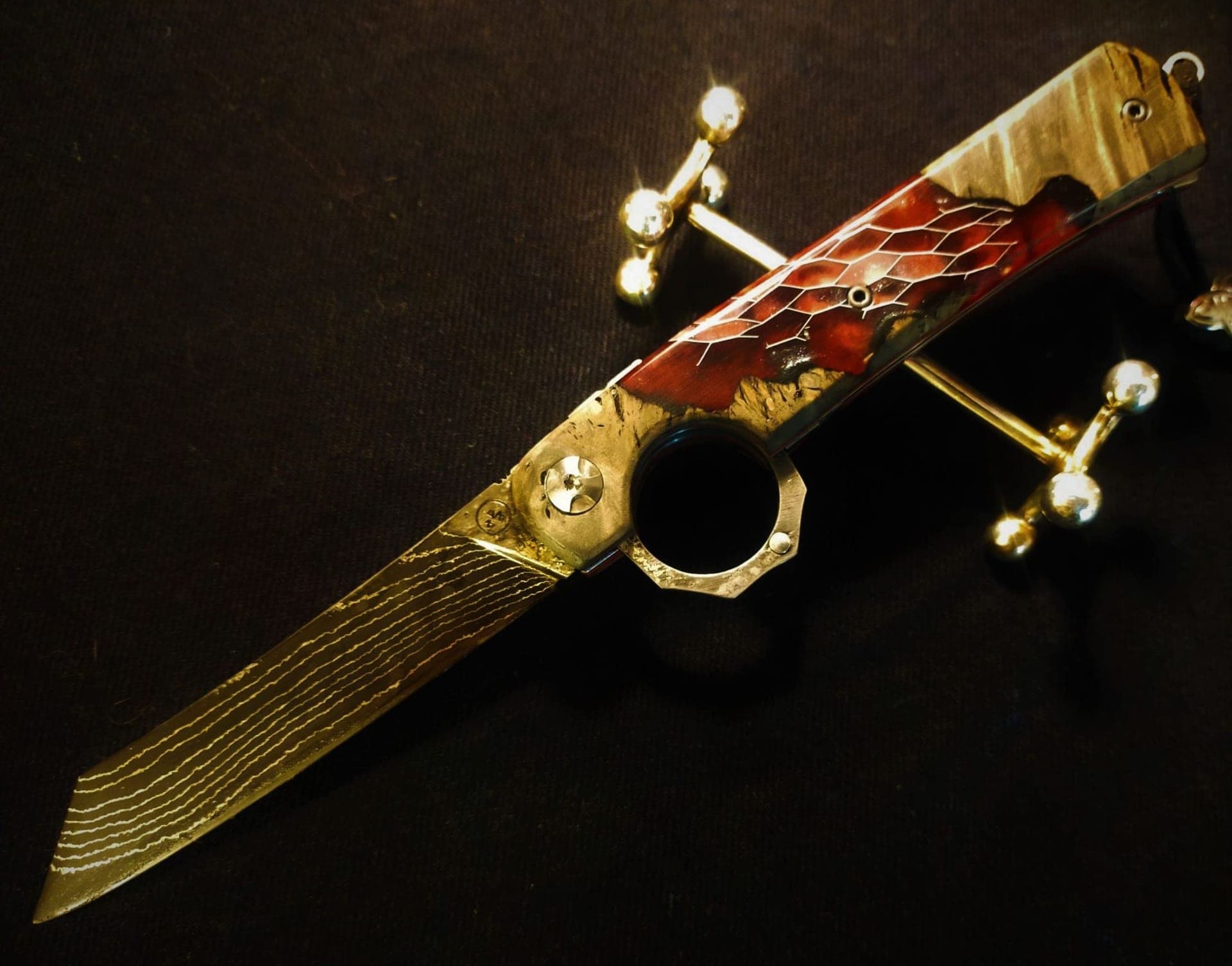
Pattern-welded damascus figures are created on purpose. Cutting, drilling, twisting or stamping the bar deforms the layers deep inside; grinding then slices through them. Ladder, raindrop, twist and mosaic all come from that controlled deformation.
A simply folded damascus gives parallel, orderly lines running along the blade: the so-called banded pattern. That is the starting point, and it is already beautiful. Everything else consists of disturbing that stack so the layers surface differently.
Regular notches cut into the flanks of the bar, then forged flat again, give the ladder pattern. Holes drilled or punched into the thickness, then flattened, bring the layers up as concentric circles: that is the raindrop. A bar twisted hot on itself gives the twist, whose volutes change with the number of turns.
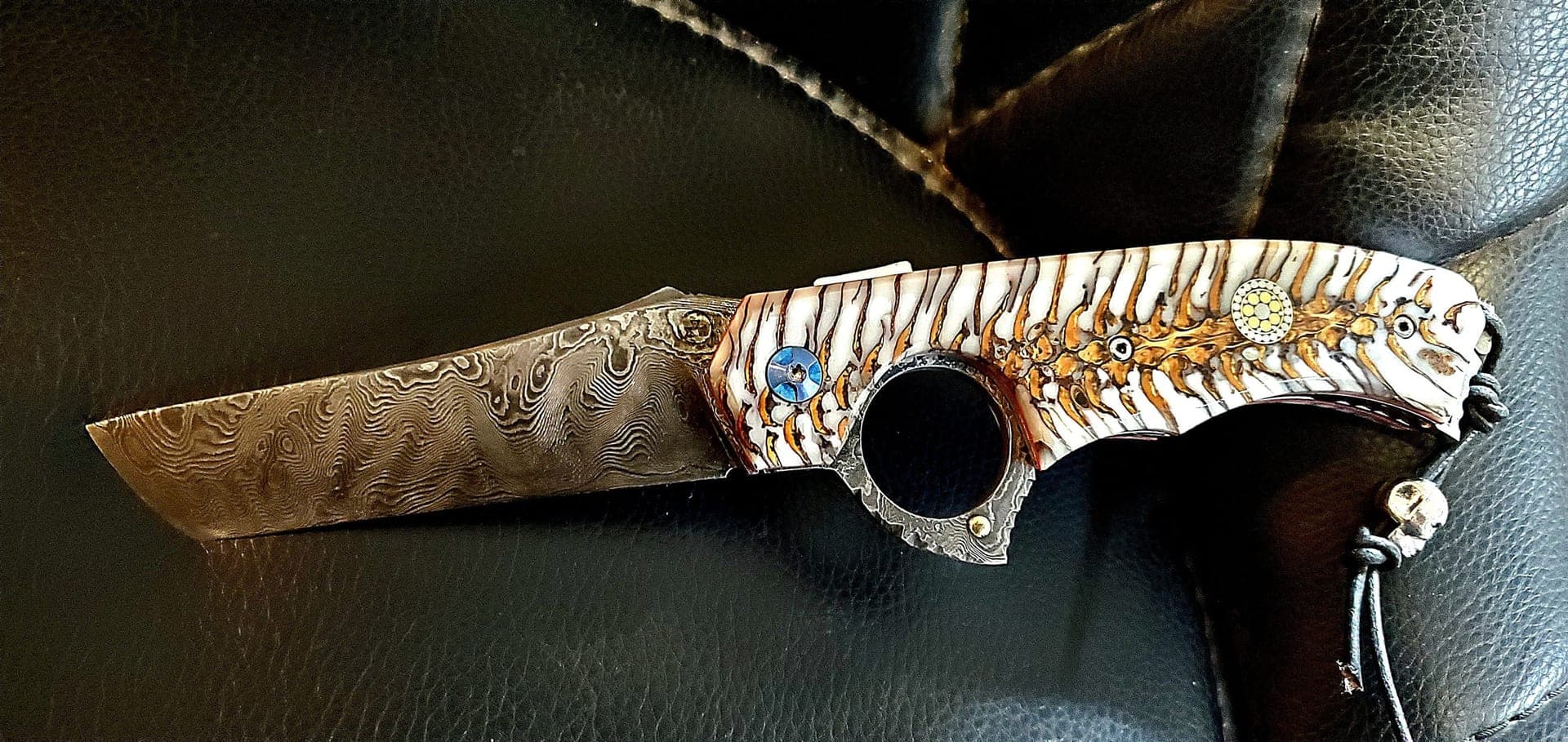
Mosaic damascus goes further still: prepared bars are assembled like the tesserae of a marquetry, to produce a chosen, sometimes figurative, motif. And Japanese suminagashi, whose name means « flowing ink » and comes from the art of marbled paper, uses many fine layers wrapped around a cutting core, for a smoked rather than watered look.
The reveal always comes last. Once the blade is finished, polished and degreased, it is dipped for a few minutes in an acid solution, often ferric chloride. The more reactive layers recede and darken, the others resist. The pattern will not change again: it lives in the material, and it will go down with it at every sharpening.
What damascus does to a blade, and what it does not
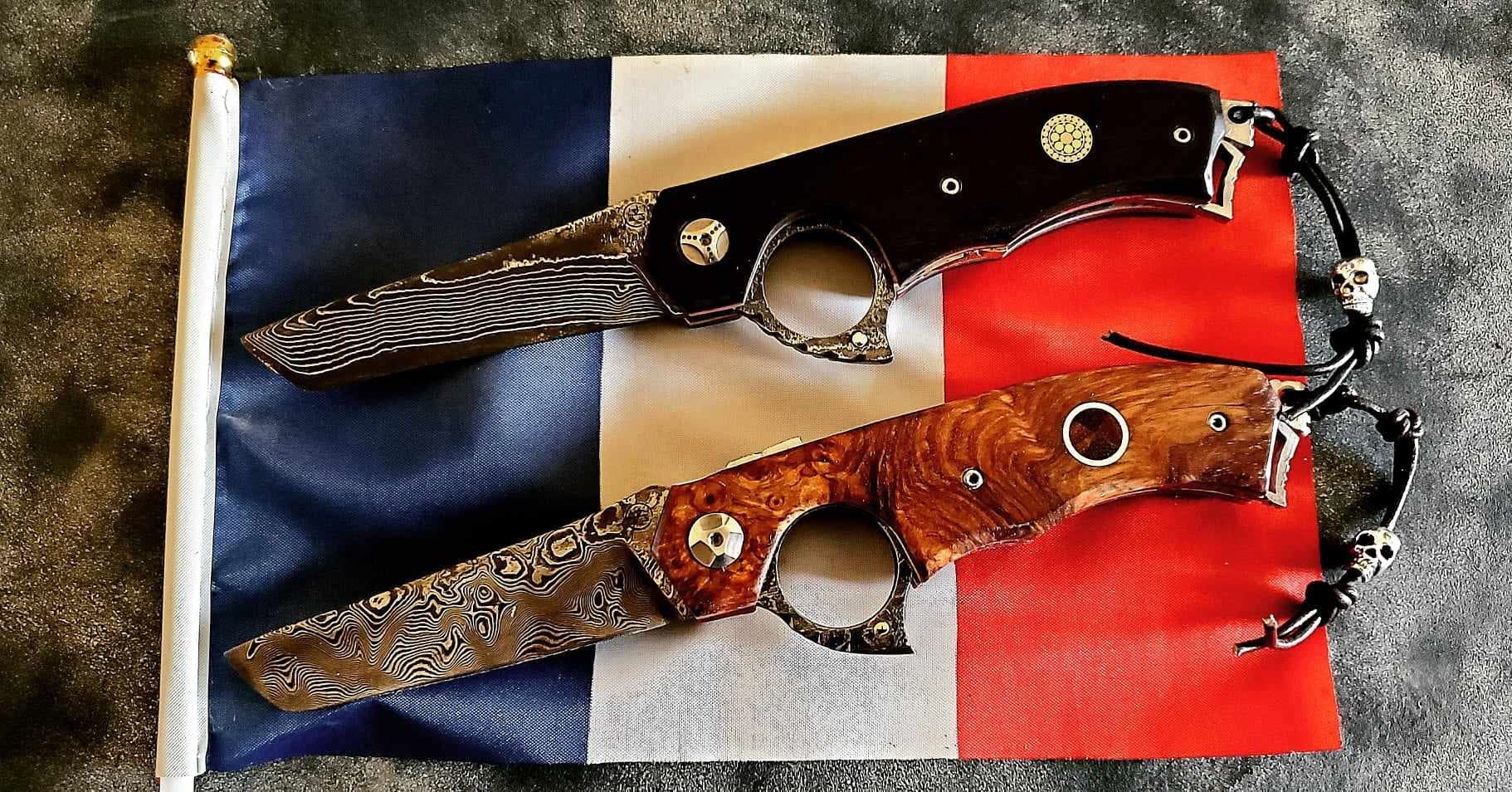
Damascus is not sharper than a monosteel blade. The edge depends on the steel grade, the heat treatment and the grind angle, not on the number of layers. Carbon damascus develops a patina and can rust: it needs the same care as any carbon steel.
This is the most stubborn myth, and it deserves to be said plainly: a damascus knife does not cut better because it is damascus. On a modern blade, cutting quality comes from the steel grade at the edge, the fineness of the grind, and above all from a properly conducted heat treatment.
What was once true no longer is. Forge welding historically served to homogenise irregular steels and to marry hardness with resilience, for lack of reliable metallurgy. Today, a well-treated industrial steel offers a consistency folding no longer provides. Damascus has become an aesthetic choice and a piece of authorship, which is considerable enough.
Then there is upkeep. Most artisanal damascus combines carbon steels: it patinas, it darkens, and it rusts if put away damp. A damascus blade should be dried after use, lightly oiled and stored dry. Stainless damascus exists, more stable, usually with a quieter contrast.
Finally, a pattern on its own proves nothing. There are very cheap imported blades showing a nondescript damascus figure and a mediocre steel at the edge. The right question is never « how many layers? » but « which steels, who forged them, and how was the blade treated? ».
Damascus at the Résiliant workshop
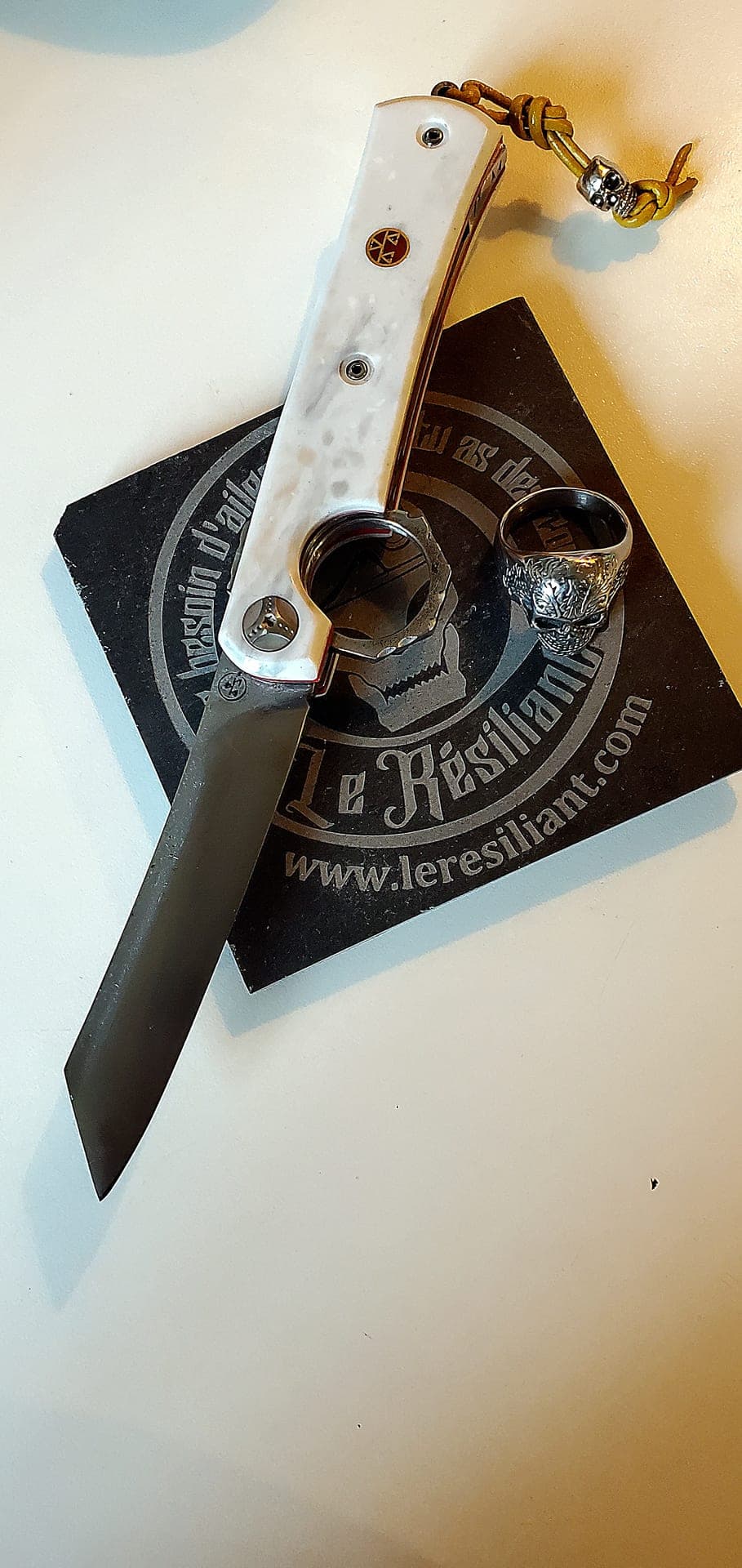
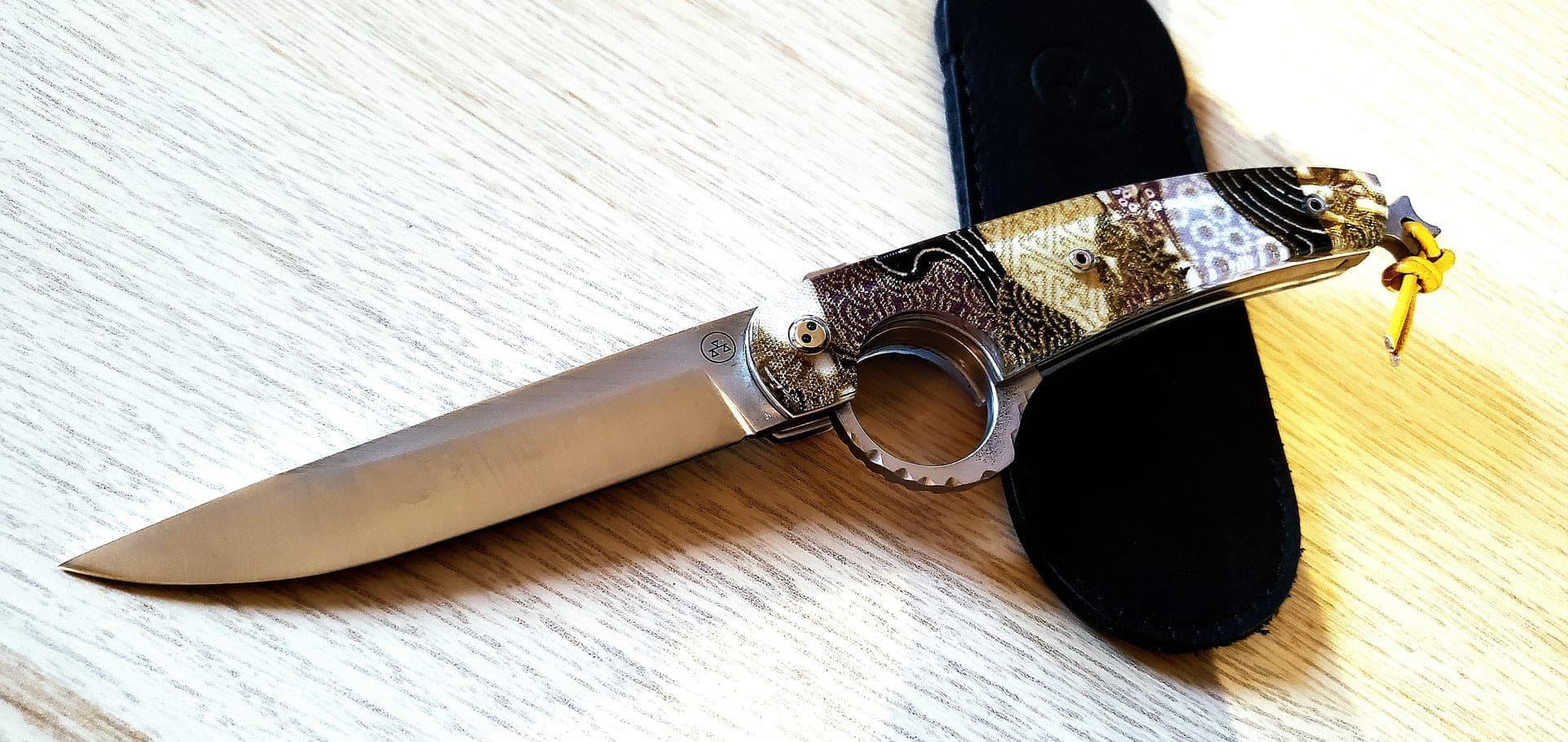
At Le Résiliant, damascus is reserved for the most accomplished pieces: L'Archétype, made in damascus only, and Le Shotokan in suminagashi or artisanal carbon damascus. Every blade is mounted on the reverse-opening mechanism invented in the workshop, in Thiers.
Not every blade calls for damascus. A pocket knife meant for daily bread and cheese needs a steel that is easy to resharpen above all; that is the role of 90MCV8 or N690 in the collection. Damascus is kept for pieces where the eye matters as much as the cut.
L'Archétype is one of them: the culmination of five years of fitting and adjusting, it exists in damascus only. Le Shotokan, inspired by the Higonokami, comes among others in suminagashi and artisanal carbon damascus. Le Fhiers, a tribute to the cutlers of Thiers, wears its layers as a signature too.
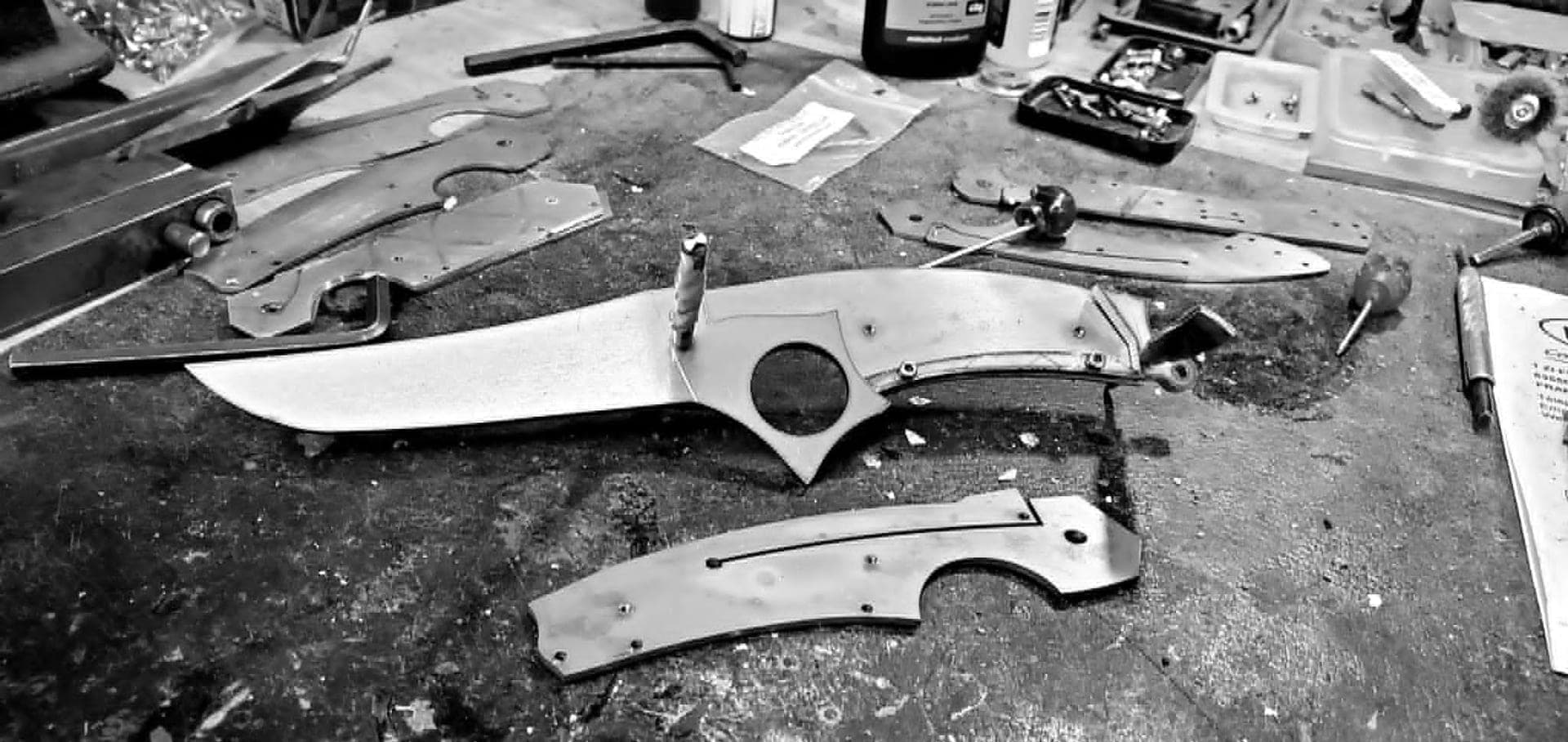
On each of these knives, the pattern meets something else: the reverse-opening mechanism, imagined in the workshop, which existed nowhere before. A material a thousand years old, a gesture only a few years old. That is exactly the kind of encounter we look for here.
- Does a damascus steel knife cut better?
- No. The edge depends on the steel grade at the cutting edge, the heat treatment and the grind angle, not on the damascus. Today damascus is an aesthetic choice and a piece of forging work, not a gain in cutting performance.
- How many layers make a good damascus?
- There is no right number. Layers double with every fold, so several hundred are easy to announce. What matters is the steels used, the cleanliness of the welds and the heat treatment of the blade.
- Does a damascus knife rust?
- Most artisanal damascus combines carbon steels: it develops a patina over time and can rust if left damp. Wipe it after use, oil it lightly and store it dry. Stainless damascus exists, with a quieter contrast.
- Can a damascus pattern fade away?
- The pattern runs through the whole thickness of the steel: normal use will not erase it. Abrasive polishing or heavy rust removal can dull it at the surface, but a cutler can bring it back with a fresh acid etch.
- What is the difference between damascus and suminagashi?
- Suminagashi is a Japanese damascus whose name means « flowing ink ». It wraps a cutting core in many fine layers for a smoked pattern, whereas European damascus alternates two contrasting steels through the whole blade.
- Why is a damascus blade more expensive?
- Because it takes extra hours at the forge, several welding heats, careful grinding and an acid reveal, with a real risk of scrap: one failed weld condemns the bar after all that work.
Sources
- Acier de Damas — Wikipédia — Distinction entre le wootz historique et le damas de corroyage moderne, disparition du savoir-faire au XVIIe siècle.
- Verhoeven, Pendray & Dauksch — The Key Role of Impurities in Ancient Damascus Steel Blades (JOM, 1998) — Étude métallurgique de référence : le motif du wootz vient d'un rubanement de carbures déclenché par des traces de vanadium.
- Knife Steel Nerds — Wootz, the true Damascus steel ? — Synthèse technique et sourcée sur le wootz, les carbures et les tentatives de reproduction modernes.
- Suminagashi (type d'acier) — Wikipédia — Le damas japonais dit « encre coulante », emprunté à l'art du papier marbré du XIIe siècle.
- Couteau Magazine — L'acier suminagashi, l'art de la révélation de l'acier — Presse spécialisée coutellerie : structure en couches, nombre de strates et révélation du motif.